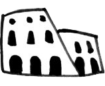
STRATEGIA COSTRUTTIVA
| HOW THE COLOSSEUM WAS BUILT The following is my translation of the chapter on the building philosophy of the Colosseum (from Giuseppe Cozzo, Il Colosseo - Fratelli Palombi Editori - Roma, 1971).
AN
approximate estimate of the workers necessary to build the amphitheatre, in the brief span
of time confirmed by historical documents, concluded that their number was so great that
it could have been impossible for them to be occupied on the surface of the amphitheatre
at the same time. These pictures show the vaults (left) and the travertine pillars (right)
Now, almost all these large arches show a striking external arrangement: the way they end up near the edge of the travertine pillars would lead one to think that there is no supporting surface. If this had been true, then the existence of the arches and the corresponding travertine pillars would not be justified. Instead, an accurate investigation, carried
out where the arch has disappeared, or where a part of the facing is missing, has revealed
the existence of a supporting impost emerging from the sides of one of the travertine
blocks placed in the upper part of each pillar. This internal impost, hidden by the
external facing, ensured support and stability to the arch. The image on the right (taken from Cozzos book) shows how the travertine blocks of the external facade, with sculpted half columns, have been sometimes mounted overlooking the best practice (i.e. placing blocks of the same size one on top of the other), perhaps with the intent to speed up the completion or to optimise the use of the stones. On the ground floor, for instance, where the intermediate travertine pillars in the radial structures present also some projections and hollows so as to ensure the grip with the tufa opus quadratum structure, nothing excludes that this opus quadratum was built independently from the rising of the pillars. Actually, this independence is demonstrated by a certain length of a radial wall, in which the base of the opus quadratum is completely independent from the base of the travertine pillars. If this independence does not result
at first sight equally evident in all the radial walls of the ground floor, we can be
completely be assured of its existence by a great lot of little details that cannot escape
a careful investigation. On the other hand, it is sufficient to demonstrate it in some
points, to accept it for the rest of the building. On the second floor of the amphitheatre
this independence between the travertine pillars and the tufa or brick walls is
demonstrated beyond any discussion by photographic evidence. This building procedure, both simple and evident, allowed to build very quickly the big cavea and to shelter the walkways on the second floor; at the same time it allowed for the coexistence of two vast building yards on the same site; a first one, below, completely covered, sheltered from the rain, and a second upper one, above the cavea, working on the upper part of the amphitheatre. Below, in the construction sites under coverage, were completed all the walls between the travertine pillars, the rampant bridging of the stairs, the vaults of the ground floor walkways, the plastering and the stuccoes. Above, work could be carried out on the walls of the remaining two floors of the amphitheatre, the podium, the seats, and the wooden upper portico. It is singular that this system recalls a scheme of caging frequent in the Roman provinces of Africa, e.g. in Timgad, with networks of stone pillars and beams. The system survived in the Middle Ages in an interesting form in the so-called Torri Pisane, of the XII century, where the stone pillars, the gothic arches and the beams in the middle consitute a frame for the brick filling of the walls. There the same concept is inspired to a similar purpose: separating the skeleton from the filling so as to quickly accomplish the job by multiplying the space of the building site, creating a big surface of superimposed floors, dividing and attacking the work from more points. We find today the very same concept in the recent buildings made with concrete and steel that represent the latest novelty of rapidity in modern construction. So, the rise of the highest skyscrapers in North America was achieved so quickly to that we are in amazement just like when we think of the building of the Colosseum. |